

The inheritance of failure
And why it matters in global health

This is the story I told at The Nocturnists/Moth event this Wednesday at UCSF:
I was eleven, living in High Wycombe, a small town outside London, on a 1970s housing estate that could have passed for Privet Drive: rows of red-brick, faux-Tudor houses with clipped hedges and an air of middle class respectability. My mum had gone back to work as a surgical nurse at Wycombe General Hospital, now that all of us kids were in school. Twice a week she didn’t get home until after ten, tired and smelling faintly of antiseptic and instant coffee. That evening it was just my dad and me at home.
My dad is brilliant at many things. He is a preacher, a reader, a man of words who can quote Martin Luther King Jnr and Martin Lloyd Jones in the same breath. But he is not practical. In our house, flat-pack furniture was an existential threat; “do it yourself” really meant “pray first.” So when he decided on a whim to repaint the dining room, I already knew it would end badly.
I was watching ‘The Bill’ on ITV when I heard a thud, then a chair scraping, followed by the unmistakable, hollow splosh of paint hitting carpet. He must have slipped. The paint can flew, and white paint exploded across the wall, the table, the carpet, the ceiling, the kitchen cabinets. No dust sheets, no covers. A perfect white arc swept from the dining room across the cabinet doors, a single shimmering stroke of disaster.
He stood there for a long moment, staring at the scene of chaos, and then quietly muttered under his breath, “I’m such a failure.” It wasn’t loud or profane, just a long, defeated exhale. I jumped up, wanting to help, but I was eleven and useless. So we ended up calling my brother-in-law, also called Mike, who is immensely practical and lived around the corner. He arrived with old towels and paint thinner, and we scrubbed until my mum got home from work. The carpet mostly came clean, the walls were fine. But my Dad’s words stayed with me.
Fast-forward twenty-five years. I’m in Botswana in 2013, two years into what I believed was my calling: running an HIV program, training doctors, caring for people in one of the highest-burden countries on earth. One in four adults had HIV. The clinics were full; the stakes felt almost holy.
My wife and I had arrived with our eight-week-old baby. We had no family or friends. It was hot, lonely, exhausting, and she hated it. Gaborone is a desert city surrounded by a million acres of heat and nothingness. The work was fascinating but the cost, especially for my family, was real.
Once a month, I drove to a place called Good Hope. The name wasn’t quite ironic, but some days it felt that way. I’d leave before sunrise, driving southwest through scrubland, passed endless thorn bushes and the occasional cow, the sun breaking across a horizon that was all fire. By the time I arrived just before 8am, the hospital would be buzzing: cramped benches, overworked staff, tired equipment. My routine never changed; a lecture, a ward round, then what we called “failure clinic,” for people whose HIV treatment was failing.
That morning after my lecture, the charge nurse led me to the inpatient ward. The smell hits you first: sweat, bleach, blood, and something sharper. She brings me to the sickest patient, a young woman newly diagnosed with HIV. Her CD4 count is under 50. She is emaciated and terrified, with weeks of discharge and pain. No one has examined her.
I ask if I can examine her, and after she nods her assent, I pull on gloves, draw the curtain, and the nurse hands me a clean speculum. At first, there was just a little blood. Then more. Then too much. It pours down her legs, soaks the sheets, pools in the curvature of the mattress between her thighs. I asked for her blood pressure—eighty-six over fifty-six. Fluids? None. Blood? All out. I stripped the pillowcase from under her head and pressed it between her legs; it turned pink, then red. Her blood pressure drops to sixty-four over thirty-four. The nearest ambulance is forty minutes away. And then she is gone. Ten minutes from the start of the exam to her last breath. She almost certainly had incurable cervical cancer. Nothing could have saved her. But all I can think is: I’m such a fucking failure. If I hadn’t examined her, she would still be alive.
It’s strange how certain words echo through a life. I failed that woman, and I wonder whether that feeling, that quiet conviction of falling short, might itself be inherited. Not genetically, but as a shadow passes from one generation to the next. If I hadn’t examined her that day, might she still be alive?
If I’m honest, failure has been woven through my professional life too, not only the rejected grants (there are plenty) or the personal absences (too many nights away from my kids), but so much of the global work itself. In fact, global health often feels like an apprenticeship in failure. Despite more than two decades of investment and the extraordinary progress we often celebrate, so much of this work is defined by failures of imagination, of political will, of collective courage. And for me, perhaps the sharpest failures are when I internalize all of those [bigger] failures as proof that I was never enough.
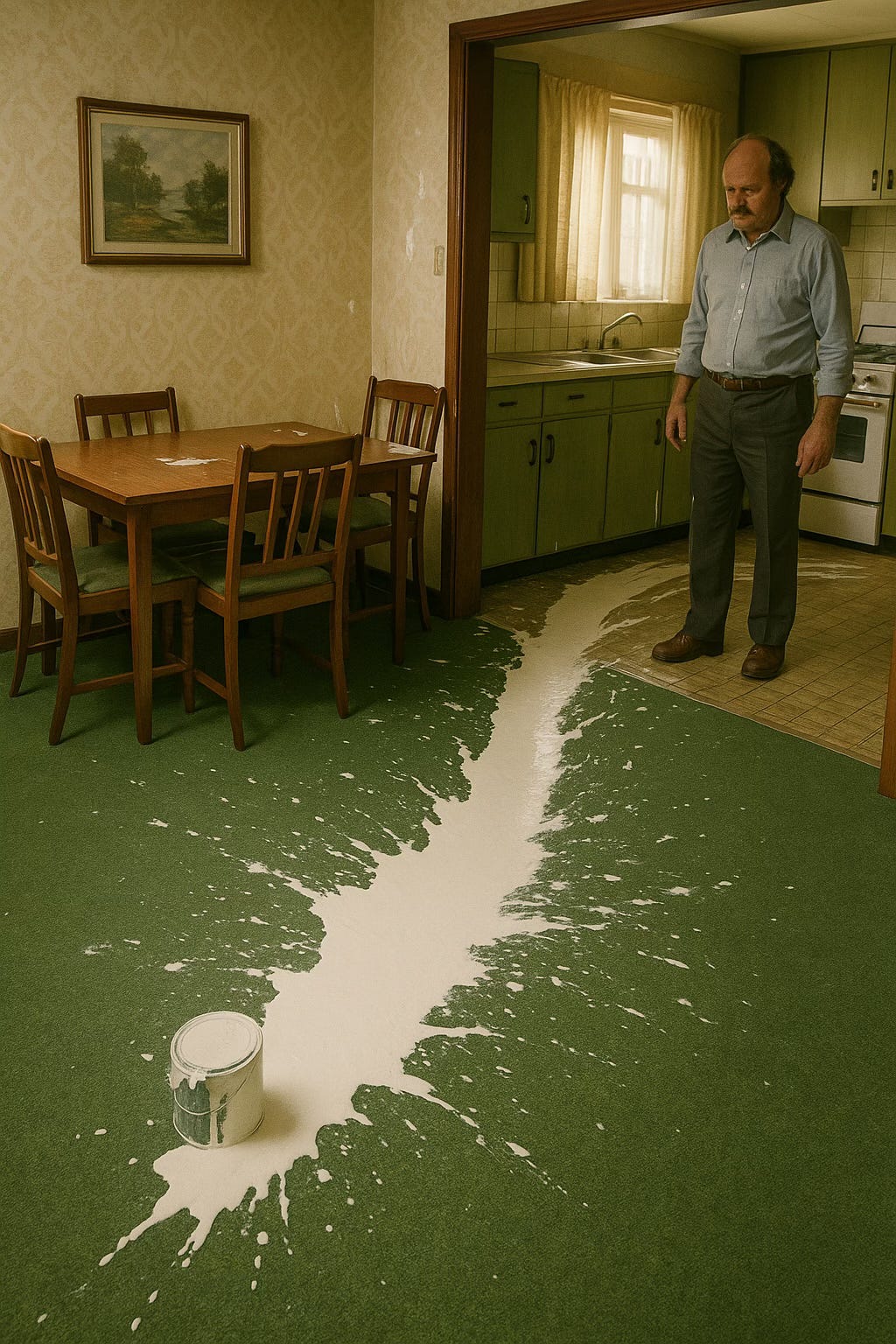
We left that house in High Wycombe decades ago. I’m sure the dining room has long since been repainted, recarpeted, remodeled. But if by some miracle that old carpet remains, I imagine the faint white stain still there, not as a monument to incompetence, but as a relic of a moment when life didn’t go to plan. A mark that remembers that someone tried.
Global health is not a quest for perfection; it is a story of persistence, of showing up again and again in the face of what is broken. And my father wasn’t a failure. He was a man who once spilled a pot of paint, a luminous, creative soul full of grace and hope. And if I have inherited anything from him, it isn’t the stain of failure, but [hopefully] the courage to keep trying.
Spot on. Thanks for this. It's particularly poignant given the upcoming Thanksgiving season. I've been thinking a lot about gratitude recently and yet, the failures of life sneak into the thoughts. It's a practice to learn from their presence.
Nice piece!
Thanks Mike for sharing this.
I read to the last word trying to know your impression about your dad and I’m happy you concluded he's a huge success.A man who raised someone like you is indeed one.Often ,we see ourselves as inadequate despite our huge achievements.That woman would have opted for you again if she came back to life because she'd have seen the efforts and care you put in which is what matters the most.
Life should be a marathon and not a sprint.If lived that way,then the efforts and persistence is what counts.Whether in life,public health,sports or business if we keep at it long enough - the fruits will come.
Keep on keeping on 👍🏼